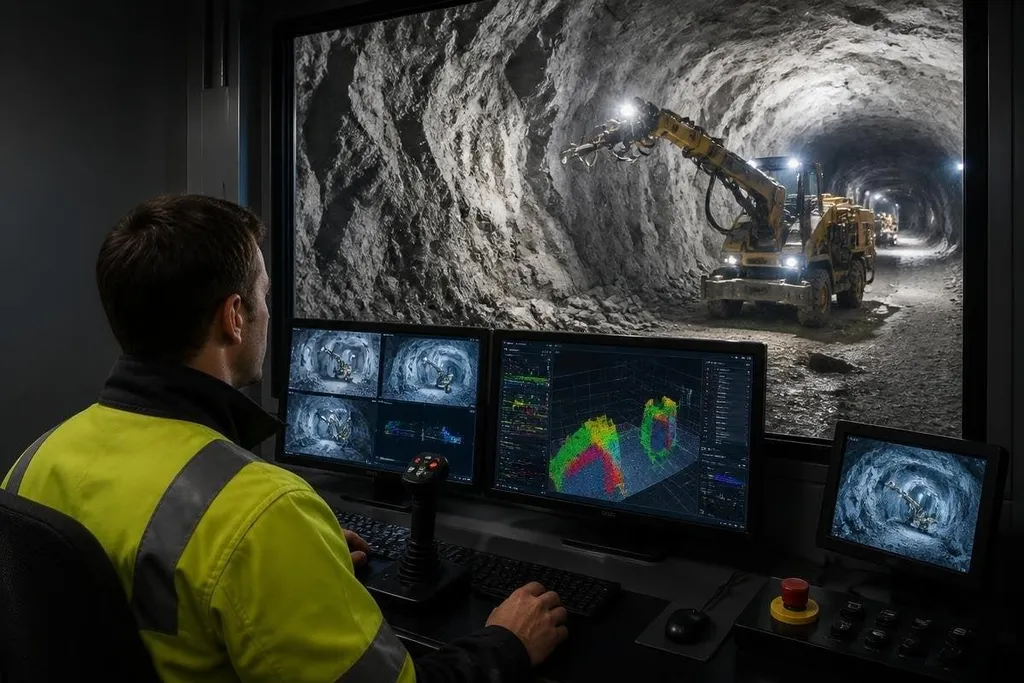
Mining robots work in places where dust, loose rock, poor light, and weak signals can stop a person or a sensor. AI gives these machines a way to read changing ground conditions, choose safer movements, and ask for help when the data is unclear.
- Cameras and LiDAR help the robot build a map of its work area
- Machine learning can spot rock, tools, people, and blocked routes
- Remote operators still matter when conditions fall outside the robot’s training
What AI adds to a mining robot
A mining robot already has motors, sensors, control software, and a task. AI sits above those parts and helps the system interpret what it sees. A camera can record a wall of rock, but a vision model can sort the image into rock, dust, equipment, and a person-shaped object.
That sorting matters because the robot needs a working map, not a stream of pictures. LiDAR measures distance with laser pulses, while cameras add color and shape. Software can combine those inputs with inertial sensors and global navigation satellite system data to estimate where the robot is and what sits around it.
The estimate will contain errors. Dust may block a camera. A metal surface may confuse LiDAR. A mine may also have areas where satellite signals cannot reach. The model can compare new sensor data with earlier readings, but the control system still needs rules for stopping when the result is uncertain.
Safer movement underground and on the surface
Mining routes change after blasting, rain, falling rock, or the movement of other vehicles. An autonomous haul truck or inspection robot needs to detect those changes before it follows an old map.
A trained vision model can flag a person, tire, cable, pool of water, or fresh pile of rock. A path planner then checks whether the route remains open. If the sensor inputs disagree, the robot can slow down, stop, or send the task to a remote operator instead of guessing.
That last step is easy to miss. AI does not remove the need for safety systems, emergency stops, geofences, or human approval. It adds another layer for reading the site.
The robot still needs tested limits for speed, braking distance, radio loss, and sensor failure. Those limits give operators a clear response when the model cannot read the site safely.
Less remote driving, more remote supervision
Teleoperation means a person controls a robot from another location. Repeated travel, route checks, or image sorting can be handled by AI, reducing the number of moments that need direct control.
The operator can then watch several machines and take over when a task falls outside the system’s training. That setup changes the job, but it does not make the operator irrelevant. A bad handoff, delayed video feed, or damaged camera can leave the person with too little information to act safely.
A lost camera or weak radio link should appear on the control screen before the operator takes over. The screen should show the robot’s location, sensor health, chosen route, battery state, and reason for stopping, so the operator knows whether to wait, reroute, or act. Reports at Robot24.com can put those details beside named mining robots, sites, and test results before you judge where the software still fails.
The limits of mining AI
AI models learn from examples. A model trained on dry, open ground may perform poorly in wet tunnels, heavy dust, changing light, or a new type of rock. The problem is not only accuracy. A wrong label can lead to a wrong route, a missed obstacle, or an unsafe stop.
Mine operators also need records of what the robot saw and why it acted. Those records help engineers check failures, update the model, and decide if a new version can run on site. Data quality matters as much as model design because poor images and missing sensor readings give the software little to work with.
I'd treat any claim of fully independent mining operation as unproven until the maker shows long runs across changing site conditions, with clear safety results and operator records.
A practical check before buying
Use this checklist when you compare an AI system for a mine:
- Name the task: Check whether the system handles inspection, hauling, drilling, mapping, or another defined job.
- Check the sensors: Ask how cameras, LiDAR, inertial sensors, and positioning data work together when dust or signal loss appears.
- Test the stop rule: Find out what the robot does when its sensors disagree or its confidence falls.
- Review the handoff: Confirm how a remote operator takes control and what information reaches them.
- Ask for site evidence: Request records collected in conditions close to your mine, not in a clean demonstration area.
- Plan model updates: Set rules for storing data, checking new software, and returning to an earlier version after a fault.
A mining robot may read its surroundings better and handle repeated work with AI. The next useful proof will come from machines that keep safe control when dust, broken signals, and new ground change the job.